Showing posts with label Health. Show all posts

Tuesday, November 27, 2012

CaringBridge

by Meredith

During this season of care, I want to plug an organization I've become acquainted and really appreciate, CaringBridge.  This web organization allows you to create your own web page/blog and share information about a person's health.  You can make it as private as you want, and can easily share it with those you want.  If someone you care about ever has a major health crisis, friends and family want to know what's going on - and you want them too.  However, if you've ever experienced this firsthand, you can understand how trying it is to keep everyone in the loop - especially when conditions are changing daily.  This is so much more simple than jumping on the phone with everyone to tell the same, long, detailed story over and over again.  This way all those 'details' can be explained one time.  And, those who care can still call and just say hello and ask how they can help instead because everyone will already know the nasty details.  Better yet - those who care, can post messages of love and support on the page, and the person experiencing all of the terribleness can read them and know how much they are cared about.

Of course you never want to 'need' a space like this, but when someone does... I highly recommend and support this organization.


Wednesday, June 23, 2010

Really? McDonalds Facing Lawsuit Over Happy Meals

The Center for Science in Public Interest is giving McDonald's up to 30 days to stop promoting toys with the purchase of their Happy Meals, saying that the company is contributing to the obesity epidemic that the country is dealing with.

As for McDonald's they insist that "getting a toy is just one part of a fun, family experience," said spokesman William Whitman.

"Tempting kids with toys is unfair and deceptive, both to kids who don't understand the concept of advertising and to their parents, who have to put up with nagging children," said Michael Jacobson, executive director of the Center for Science in Public Interest.

My personal opinion is that parents should be responsible and take control of deciding what their children eat. When I was five, If I had the choice, I would have eaten a McDonald's Happy Meal every day, but my parents of course didn't allow this. I can see the Center for Science in Public Interest's side, but cannot agree with their call to action. There are a lot of other fast food chains out there doing the same thing, but because of McDonald's size and history of success they are getting blamed for consumer's great lack of self control.

Wednesday, March 24, 2010

Obama plans blitz to boost public opinion of health care bill

The first anniversary of Obama's presidency could hardly have been gloomier. Especially since the day before on Jan. 19, Republican Scott Brown shocked the political world by winning the seat long held by Kennedy, a lifelong champion of health care reform. The ramifications were huge. Obama's public opinion rating was dropping and he hadn't brought about any change liked he promised during the 2008 election season. However, with a lot of determination, deals and luck, Obama sealed the deal on his health care plan.

On Monday, President Obama began an immediate public relations blitz aimed at turning around Americans' opinion of the health care bill and so far there's been progress. A USA Today/Gallup Poll finds that 48 percent, calls the legislation "a good first step" that needs to be followed up by more action, and 4 percent says the bill itself makes the most important changes needed in the nation's health care system.

The reshaping the legislation's image will take place in three phases, White House aids said: the immediate aftermath; the seven months until the November midterm elections; and the several years that follow, during which many provisions in the measure will gradually take effect.

Obama and those in favor of the bill have a lot more PR to do though, especially since no Republicans are in favor of it and will do everything possible to point out the negative aspects of the bill.

A lot of the public dislike of the legislation is bound to not understanding how it will affect them or suspicious about Washington and the historically low approval ratings of Congress as an institution. Turning around that sentiment will require the law to be implemented smoothly. Many Americans believe that no matter what, the government always finds a way to screw something up. White House officials say they will handle this by developing a comprehensive public education campaign that helps people understand is as it comes on.

White House officials say that Obama will not make health care a daily topic for the rest of the year, and will quickly shift to financial reform and the economy. Hearings on revamping financial regulations will begin Monday.

But officials say there will be several key moments before November's elections when popular parts of the health care legislation, such as the provision that prevents children from being denied coverage and changes to the "doughnut hole" for seniors, will take effect. Obama will surely build high-profile public events around those moments.

Wednesday, February 17, 2010

Kevin Smith vs. Southwest Airlines: 'too fat to fly' battle starts on Twitter

Over the weekend a large Los Angeles man, Kevin Smith, posted this on his Twitter page: "I'm way fat, but I'm not there just yet," and "If you look like me, you may be ejected from Southwest Air." He also posted a picture of himself sitting on the plane with his cheeks puffed out and make a podcast slamming Southwest Airlines for kicking him off.

Smith started this online rampage after a pilot ejected him from a Southwest Airlines flight, saying he didn't fit properly in a single seat. If you were Southwest Airlines, would you think his post is a big deal?

I'd say yes, because we've seen the impact social media can have and how famous it can make someone. Plus, this man is already famous for his work as a director (you may recognize him as the director of the new Bruce Willis movie "Cop Out," and he previously directed the films "Clerks" and "Chasing Amy". Furthermore, obesity is a hot topic right now.

Southwest handled the issue by doing the following:
  • Stating that their "Customer of Size" policy requires travelers must be able to fit safely and comfortably in one seat or make other arrangements
  • Issued an apology first from its own Twitter account
  • Later issued another apology on its website titled "Not So Silent Bob," a jovial jab at the Silent Bob character Smith plays in many of his films
  • Will accommodate Smith on a later flight by giving him a $100 voucher
  • Another apology - this time by phone
It should be mentioned that Smith and the airline stated that he had bought two seats for his original flight from Oakland, where he had spoken at the Macworld Expo conference. However, he was flying standby in order to catch an earlier flight and only one was available. Smith insisted that he was still able to put both armrests down and buckle his seat belt, which is Southwest's standard.

I think that Southwest Airlines did a good job handling the issue right away and taking responsibility for their decision.

Monday, November 30, 2009

Where Do Those Facts Come From? False Advertising Issues & Cheerios

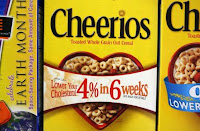
The Food and Drug Administration raised questions about three out of four studies General Mills used to support health claims for the nation's top-selling breakfast cereal, Cheerios. (One box of cereal out of every eight sold is Cheerios!) cereal This has caused concerns of false or misleading advertising.

False or misleading information in advertising is known as deceptive or false advertising. Since advertising attempts to persuade consumers into buying products, many governments around the world have set regulations to control false or deceptive advertising. Truth in labeling is essentially the same concept, that consumers have the right to know what they are buying and that all necessary information should be on the label.

This summer General Mills argued that it should be allowed to say that a diet of Cheerios cuts levels of low-density lipoprotein (sometimes referred to as "bad") cholesterol by specific amounts. October 9th, the FDA sent a letter to the company addressing two other claims. They said that the statements, which appeared on boxes reading "4% in 6 weeks" and "10% in one month," were either too short or incomplete. Under the labeling laws, Cheerios may make the claim that it may make the claim it can lower the risk of coronary heart disease when eaten as part of a diet low in saturated fat and cholesterol. The law allows food manufacturers to make a second claim that specifically mentions a certain food, for Cheerios it's oats or "whole-grain food," as long as it's made as part of the more general claim about soluble fiber.

The FDA sent a warning letter to General Mills in May that talked about serious violations of the Food, Drug and Cosmetic Act, drawing attention to the Cheerios claim that it can "lower your cholesterol 4 percent in six weeks." They said that the placement of the statement on Cheerios boxes were problematic, since the claim appeared in large print on the front of the box. A smaller, second statement appeared near the edge of the box reading cholesterol reduction also required a diet low in cholesterol. As proof, Cheerios responded by submitting four peer-reviewed studies they conducted in the past 11 years.

Barbara Schneeman, Director of the Office of Nutrition, Labeling and Dietary Supplements in the FDA's Center for Food Safety and Applied Nutrition, said in her October 9th letter to General Mills that just one of the studies, Johnston (1998), stood up to her office's review. The study supports the claim that 3 grams per day of soluble fiber (meaning three servings or 3 cups of Cheerios per day) would cut bad cholesterol by 4 percent in six weeks, Schneeman wrote. Yet, health claims must take into account not just one study, but every relevant study, according to FDA rules, and the three other studies that General Mills submitted don't seem to clearly support the claim, Schneeman wrote, referring to Karmally (2005), Reynolds (2000) and Maki (2009). Two of the studies don't report the average cholesterol reduction for people in the study who ate Cheerios vs. people who didn't eat Cheerios. The third study lasted four weeks, not the six weeks suggested in the Cheerios claim.

The FDA said that they did not hold enough strength to support the claim and that to make such a bold statement they must take into account not just one study, but every relevant study. The FDA's letter also said that both the "4 percent in 6 weeks" claim and the "10 percent in one month" claim are based on three servings (3 cups) of Cheerios daily. The letter went on to suggest that the phrases might need to be reworked to make it clear that they don't refer to a single serving. Cheerios is still standing behind belief and is battling with the FDA, but has removed the statements from their products.

This is an example of a disclaimer violation and further, a manipulation of standards violation. Often companies use disclaimers to try and absolve themselves of their legal responsibility for their own actions. Along with unreasonable conditions usually there is a fine print in hopes that consumers will commit themselves without reading it. When a company manipulates a standard, they make something have a different meaning than what it is widely understood as.

I don't think this type of advertising is right. So often in reports and advertisements we see facts that we just accept right away. We don't question really where they've come from or the resource. I think it's good that we have organizations such as the FDA, FTC and other government organizations watching out for unreliable statements and that there are punishments. I don't think that General Mills handled this situation very well at all. They do not to seem to see their statement as wrong in anyway and don't appear to be concerned with telling the public the truth. Lastly, I don't think this issue will hurt the Cheerios or General Mills brand very much, if at all, but I am glad they took these generalized samples off their products.

Wednesday, November 18, 2009

Are You Addicted to Social Media?

Social media is growing rapidly, with Twitter at the forefront growing over 1,000 percent since February. New sites are continuing to constantly rise and fall in an attempt to innovate the social media market place. Communicating has never been easier, and social networking sites help people touch base. It starts out innocently enough with people reconnecting with friends from the past. Then you start connecting with friends from work and then maybe even their friends and then sometimes even celebrities or organizations.

This new rise in social media's popularity has caused the workplace to respond harshly. Most businesses have set limits on the access to social media websites. Statistics show that over 70 percent of employers have banned such sites. This has lead to the popularity of mobile social media. Although teens are the ones who paved the way for mobile social media, it is the adults who have the most use for it. As long as there is good cell phone coverage, and the boss isn’t standing right there, a working man can get his Facebook fix at any moment in time.

You must be careful though not to become a social media addict; doctors are saying social media has started to act like a drug. Harry Haroutunian, a doctor at the Betty Ford Center in Rancho Mirage, works with people who have chemical dependencies, and he says that as technology and especially social networking expands, he's seeing more and more people with significant in-balance in their lives, spending more time isolated.

A recently released report out of UCLA states the top five signs that could mean you're addicted to social networks.
-you lose sleep over social networks (you're logged in overnight causing you to be extremely tired the next day)
-you spend more than an hour a day on networks-you become obsessed with old lovers or exes you reconnect with
-you ignore work in favor of networks
-the thought of logging off causes stress and anxiety

Dr. Harry says, "Do I have a tolerance to (social networks), like someone can build a tolerance to drugs that's more and more exposure is required to get the satisfaction or the 'high' from using the technology and are there withdrawal symptoms if I try to stop suddenly."

I'm a big fan of social media, but I wouldn't say I'm addicted to it. I do not feel stressed when I can't reach it for awhile and I don't have the Internet attached to my phone so I don't have to worry about using it while away from my computer. However, I do see how social media can consume a lot of one's time. There are so many social media tools to use and you must update yours often and keep up with friend's changes to know what is going on. I can take a lot of time! Just make sure you're not giving up other aspects of your life and watch how much time you spend on it. Lastly, remember people do not need to know everything you're doing or what you think at all times!!!